Again, some thoughts on dreams - which have been elbowing their way into my nocturnal sojourns recently, more insistently than usual. They stay true to form for the most part: technicolor, high definition, a cast most often composed of strangers, yet who seem completely familiar with the primary protagonist - me.
Recently however, as I think I may have mentioned, there have been a few guest appearances by people I know - but I recognize them only after waking; "Hey, I think that was so and so." Also, a recent aberration has been the "to be continued" dream. Those are the ones where you wake up, get a drink of water, go pee, check the weather, something - and go back to sleep. Then, whamo! There you are back in the same dream. This appears to be a phenomenon over which I have no control, since when I want to return to a dream to see how things turnout, it never works.
OK. So what? Well, I have found myself recently thinking about the notion that unlike much of contemporary existence which is crafted by shared, posted, texted, screened, emailed, cell-phoned or reported, expressions; dreams are experiences that are completely private. Oh, we can write about them, or talk about them to friends, lovers, family, therapists, whatever. But those descriptions are mandatorily second-hand. And the insights of those others, no matter how well intentioned, are still intrinsically interpretations from outside the dreamer. The pure experience of the dream is totally internal. Like the pearl within the oyster - the dream in its natural state, is invisible to the world outside.
It is, of course, a common calling of the artist to externalize the dream. And in some ways, all art is an attempt to make the internal insight perceivable to others. And tho' some artists refuse to discuss the meaning in their art - I am among them when it comes to visual art, not because I am being secretive I just don't really know where some of them spring from. I still contend that, whether visual, audible, tactile or some combination thereof, art draws some shy perception out of internal shadows into the sunlight of external examination. And while the meaning of those external examinations may be up for grabs it is, to some extent, the degree to which that artistic reveal is successful that determines the value - and staying power - of the artwork.
But that assertion requires some clarification, and draws into necessary consideration the newly coined notion of the meme. The word was advanced by Richard Dawkins' 1976 work, The Selfish Gene, to describe how cultural information spreads.
So a meme is any sort of cultural item - such as an idea, behavior, image, or video - that spreads rapidly from person to person across the internet, usually through social media platforms. An example of an early meme which is often cited is the ":-)" which many text-based platforms automatically convert to this icon: 🙂. Something called an "emoticon." An icon that conveys an emotion. And they are handy little guys especially for those of us who were raised in the un-evolved environments in which "keyboarding skills" were primarily intended for young women destined to become secretaries. I, a two- sometimes four-fingered typist - use them often myself.
But it is important to remember that emoticons, like many contemporary memes, are a type of communication shorthand. They attempt to "stand for" larger, often more complex communicative messages, structures or systems. I tend to think of them being similar to runes, or cuneiform or hieroglyphics. Writing systems restricted by medium [runes in stone, cuneiform in clay] or specialized skills or social status [hieroglyphics]. But still shorthand.
While watching one of our recent snowfalls I realized that I still remembered all of Frost's Stopping by Woods on a Snowy Evening. You know; "Whose woods these are, I think I know . . ." And I wondered how that poem would be constructed with emoticons? I mean think of really old works, Beowulf, The Epic of Gilgamesh? I admit I am intentionally not doing an Internet search for "emoticon poetry." Oh, who am I kidding:
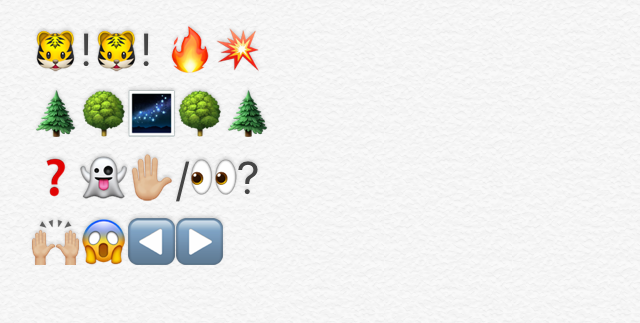
I'm thinking this is supposed to be "Tiger, tiger, burning bright! In the forest of the night." But if I didn't already have some memory of the poem, I doubt I would have been able to translate. My memory is incomplete so the last two "lines" remain a mystery to me.
For me the issue remains that our art seeks to externalize, to reveal the internalized scenes that we contain - we are the oyster, our dreams are the pearls.
Memes and emoticons are the shells.

No comments:
Post a Comment